Recently while reading XKCD I came across the mention of a fourth dimensional game. When I researched it I foudn that it does not exist yet but that it has won some design awards. I then checked out some other games that won similar awards and found some really fascinating games. Many of these games are short games that you can finish in less then a week or even an hour, but they are note worthy because of the way they play the game.
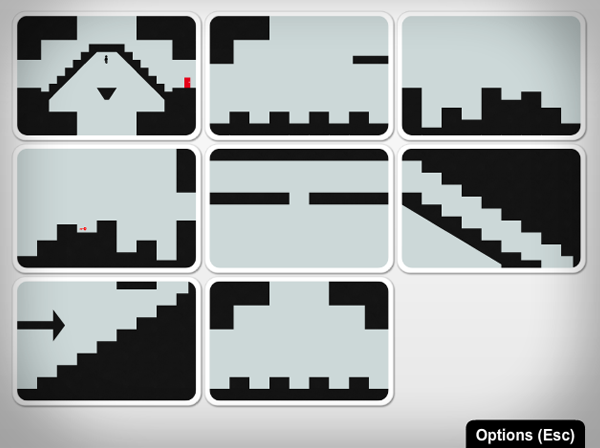
The first one I want to mention is called the continuity game. The game is a side scrolling game similar to Super Mario but with really simple clean graphics. The catch is that you can rearrange the levels by sliding the cards around. As long as the edges of the cards match up your character can move between them. Also as you play there is beautiful, calm music playing.
The second game is more artistic. It is called a puzzle poem because the game is a poem in which you switch out nouns and verbs. The game is the title of the poem "Today I die." As you do this it takes you through the story of the poem to the conclusion. I almost think of it as more art than game. It is a really neat concept that I have never seen applied to a game structure before. To add to the mood the poem also has music playing in the background.
If you have a moment I suggest you check out both of these games.
Showing posts with label cool. Show all posts
Monday, April 12, 2010
Friday, March 26, 2010
Tuesday, November 24, 2009
Farming Up
I came across the idea of farming in skyscrapers a couple of years ago. The idea seemed interesting and far fetched at the time. Lately though I have been running across this idea everywhere I go on the internet. (With that said I go to some pretty nerdy places). First I came across it recently again in Scientific American the November 2009 issue. Then while reading an interesting article about farming Detroit I linked over to an article about how Detroit is a food desert and there are possible plans to turn parts of it into farm land again or to turn the skyscrapers into hydroponic farms. Then today I saw that vertical farming was the spotlight story in the technology section at the CBC website.
So what is vertical farming? In a few simple words it is farming in a skyscraper. It is obviously more involved than that but it gets across the general gist of the concept.
So why farm in a skyscraper?
The various articles give a number of reasons. I will try to sum up the major ones below. These are in no particular order.
1) The farms can be built into the cities water management systems to better use waste water.
The idea here is that the farm building has a water treatment center in it and that municipal waste water gets purified enough to water the plants and the solid wastes are burned to provide energy. This would help to deal with city water management problems and provide water and energy for the farm. (it may need to supplement its energy with other sources of power still)
2) There is not enough land to keep farming using current methods if the population continues to grow.
I do not know how accurate it is but many different articles from different sources all seem to say that we will run out of farmland within the next 50 years. This includes if we just wholesale clear cut all current forests. The only way to allow for a growing population is to provide more food. In order to do that we need to have more farming in a tinier area. This means many storied farms.
3) Limited water supply.
We have all heard that water supplies are going to become more and more scarce as more people have to share them. In a controlled environment like a building you can recapture any water that evaporates off of plants and reuse it. You can also use things like drip irrigation to reduce the amount of water you need.
4) Access to quality food.
While most of us have access to good food this food has often traveled around the world to get to us. If we had vertical farms then you could have farms right in the city and they could provide local produce year round to grocery stores. You might even have a grocery store right on the first floor of the farm.
5) Pollution reduction.
This would reduce all the pollution that is used to ship it to you normally. It would likely take some time before the reduction in transportation pollution was greater than that of constructing the building but it would eventually be greener.
6) Local jobs
Running a large farm like this would generate jobs. The fact that there is a growing population means that this would not take jobs away from current farmers as they will still be needed as well.
7) Save wild landscapes
If we can build these kinds of farms then we do not need to expand farmland into areas that are currently still wild areas.
There are likely many more ideas. I would like to hear what different people think about this concept. One business model idea I had about it would be to have people that cannot use all of their own compost to give it to the vertical farms. They then get a share in the produce being grown. Kind of like a Co-op or something.
Well let me know what you think. Also if you want more information the website that seems to be the collecting point for all things relating to vertical farms is www.verticalfarm.com .
So what is vertical farming? In a few simple words it is farming in a skyscraper. It is obviously more involved than that but it gets across the general gist of the concept.
So why farm in a skyscraper?
The various articles give a number of reasons. I will try to sum up the major ones below. These are in no particular order.
1) The farms can be built into the cities water management systems to better use waste water.
The idea here is that the farm building has a water treatment center in it and that municipal waste water gets purified enough to water the plants and the solid wastes are burned to provide energy. This would help to deal with city water management problems and provide water and energy for the farm. (it may need to supplement its energy with other sources of power still)
2) There is not enough land to keep farming using current methods if the population continues to grow.
I do not know how accurate it is but many different articles from different sources all seem to say that we will run out of farmland within the next 50 years. This includes if we just wholesale clear cut all current forests. The only way to allow for a growing population is to provide more food. In order to do that we need to have more farming in a tinier area. This means many storied farms.
3) Limited water supply.
We have all heard that water supplies are going to become more and more scarce as more people have to share them. In a controlled environment like a building you can recapture any water that evaporates off of plants and reuse it. You can also use things like drip irrigation to reduce the amount of water you need.
4) Access to quality food.
While most of us have access to good food this food has often traveled around the world to get to us. If we had vertical farms then you could have farms right in the city and they could provide local produce year round to grocery stores. You might even have a grocery store right on the first floor of the farm.
5) Pollution reduction.
This would reduce all the pollution that is used to ship it to you normally. It would likely take some time before the reduction in transportation pollution was greater than that of constructing the building but it would eventually be greener.
6) Local jobs
Running a large farm like this would generate jobs. The fact that there is a growing population means that this would not take jobs away from current farmers as they will still be needed as well.
7) Save wild landscapes
If we can build these kinds of farms then we do not need to expand farmland into areas that are currently still wild areas.
There are likely many more ideas. I would like to hear what different people think about this concept. One business model idea I had about it would be to have people that cannot use all of their own compost to give it to the vertical farms. They then get a share in the produce being grown. Kind of like a Co-op or something.
Well let me know what you think. Also if you want more information the website that seems to be the collecting point for all things relating to vertical farms is www.verticalfarm.com .
Sunday, October 25, 2009
New Banner!
Thanks goes out to May-B for the new banner. I will do my best to live up to the description on it.
Saturday, February 09, 2008
Human Power: The new renewable power
There is an interesting invention that has come out of Simon Frasier University. If you want a video clip check this out. It is basically a knee brace that generates power as you walk. I will try to explain this for everyone that might read this.
When you step forward your body swings your calf forward. You can think of this like a swinging weight. If the energy of your swinging forward calf had to be completely stopped by your knee you would quickly wear your knees out. To stop that from happening our bodies have muscles that slow our leg down as it straightens out. You can imagine these muscles as the brakes for our legs. Again, without these muscles your knee would have to do all the stopping of the leg. This would be similar to always stopping your car with the emergency brake.
So why did I explain the way your leg works and not the device? Well you need to understand that your leg already has a brake built into it. What this new knee brace generator does is help slow your leg down at the end of the step. (This is similar to a hybrid car using the forward energy given off by a car as it brakes to charge the battery) It does this by having your leg turn a small generator ( the reverse of an electric motor). This does not create any extra effort to walk. It will not be like trying to walk in knee high water or anything like that. The only extra work your body does is carry around a few extra pounds, and that will diminish as future versions get even lighter.
Some other quick details that the article listed:
1) It generates about 5 watts of power while at a normal walk. According to my quick research on Duracell's website, a regular AA can generate about 1 watt of power for about 75 minutes. That means that this is as good as about 5 continually new AA batteries. This is actually a lot of power. According to the article 1 minute of walking could power 30 minutes of cell phone use.
2) It weighs about 1.6 kilograms (3 1/2 pounds)
So with all of this in mind what can we use it for?
The first application suggested in the article is that it could power electric prosthesis so that amputees would not have to wear battery packs. There are also a wide range of other similar medical suggestions. For example any sort of monitoring unit that a person might wear or any sort of device like a pacemaker that might require power.
Another application is of course military in nature. Soldiers could use it to power their GPS units and other handheld devices. This would mean that they would have virtually unlimited battery life and would be in less danger of falling out of contact.
The exciting applications are when you start to think about every day use. The reason many portable devices are so bulky and limited in there abilities is that they require enough battery life to be practical. Once you improve the battery life they can add many more applications.
A classic example is the IPhone. When it came out everyone complained that it could not use the internet and talk at the same time. This is something that is not possible for second generation GSM edge technology. That is why almost all new phones being offered by AT&T (the company selling the IPhone) use third generation GSM umts technology. It allows the user to surf the internet or send a video from their camera while still talking on the phone via their bluetooth. It also allows the internet to be faster. It is like going from dial-up internet to broadband. So why would Apple release a phone that is clearly inferior in its internet and data usage? The official reason is that the computer chip for umts is a power hog and it would shorten the battery life unacceptably. Until they can resolve this battery problem Apple won't release a 3G umts IPhone.
No imagine if battery life were not a problem for portable devices. The displays may be thinner, storage may be a little higher, screen size a little bigger for watching video, internet a little faster. There are also a variety of other things that may eventually be possible that will require a power source like this one. One is a shirt that has a tv built in. It is flexible screen technology and it would be like having the ipod screen built into a patch on your sleeve. If that is a little too weird for you then maybe just a shirt that can change its colour using electricity. You may also have shoes that track your running and workout stats. That would be cool.
I'd like to hear what other people think about this.
When you step forward your body swings your calf forward. You can think of this like a swinging weight. If the energy of your swinging forward calf had to be completely stopped by your knee you would quickly wear your knees out. To stop that from happening our bodies have muscles that slow our leg down as it straightens out. You can imagine these muscles as the brakes for our legs. Again, without these muscles your knee would have to do all the stopping of the leg. This would be similar to always stopping your car with the emergency brake.
So why did I explain the way your leg works and not the device? Well you need to understand that your leg already has a brake built into it. What this new knee brace generator does is help slow your leg down at the end of the step. (This is similar to a hybrid car using the forward energy given off by a car as it brakes to charge the battery) It does this by having your leg turn a small generator ( the reverse of an electric motor). This does not create any extra effort to walk. It will not be like trying to walk in knee high water or anything like that. The only extra work your body does is carry around a few extra pounds, and that will diminish as future versions get even lighter.
Some other quick details that the article listed:
1) It generates about 5 watts of power while at a normal walk. According to my quick research on Duracell's website, a regular AA can generate about 1 watt of power for about 75 minutes. That means that this is as good as about 5 continually new AA batteries. This is actually a lot of power. According to the article 1 minute of walking could power 30 minutes of cell phone use.
2) It weighs about 1.6 kilograms (3 1/2 pounds)
So with all of this in mind what can we use it for?
The first application suggested in the article is that it could power electric prosthesis so that amputees would not have to wear battery packs. There are also a wide range of other similar medical suggestions. For example any sort of monitoring unit that a person might wear or any sort of device like a pacemaker that might require power.
Another application is of course military in nature. Soldiers could use it to power their GPS units and other handheld devices. This would mean that they would have virtually unlimited battery life and would be in less danger of falling out of contact.
The exciting applications are when you start to think about every day use. The reason many portable devices are so bulky and limited in there abilities is that they require enough battery life to be practical. Once you improve the battery life they can add many more applications.
A classic example is the IPhone. When it came out everyone complained that it could not use the internet and talk at the same time. This is something that is not possible for second generation GSM edge technology. That is why almost all new phones being offered by AT&T (the company selling the IPhone) use third generation GSM umts technology. It allows the user to surf the internet or send a video from their camera while still talking on the phone via their bluetooth. It also allows the internet to be faster. It is like going from dial-up internet to broadband. So why would Apple release a phone that is clearly inferior in its internet and data usage? The official reason is that the computer chip for umts is a power hog and it would shorten the battery life unacceptably. Until they can resolve this battery problem Apple won't release a 3G umts IPhone.
No imagine if battery life were not a problem for portable devices. The displays may be thinner, storage may be a little higher, screen size a little bigger for watching video, internet a little faster. There are also a variety of other things that may eventually be possible that will require a power source like this one. One is a shirt that has a tv built in. It is flexible screen technology and it would be like having the ipod screen built into a patch on your sleeve. If that is a little too weird for you then maybe just a shirt that can change its colour using electricity. You may also have shoes that track your running and workout stats. That would be cool.
I'd like to hear what other people think about this.
Subscribe to:
Posts (Atom)